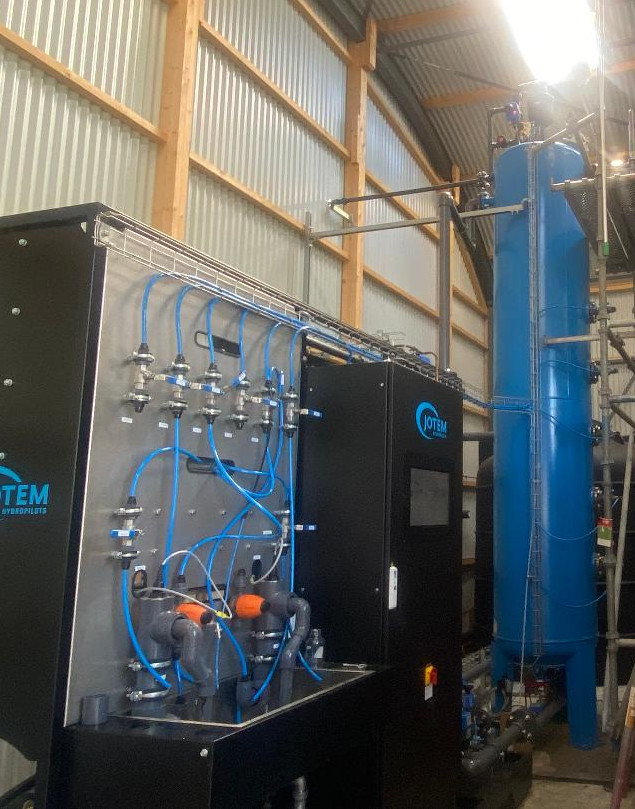
BODAC®’s activated carbon granules at Nieuwater have been working miraculously well. Though meant for ultra-pure water synthesis, its capabilities in all sorts of organic micropollutant removal have not gone unnoticed. Dr. Amanda Larasati et al. describe in a new  paper in Chemical Engineering Journal what core elements make the technology work, and what at we need to know to apply Nieuwater’s knowledge elsewhere.
Unexpected success
It’s been well over a decade since the Puurwaterfabriek introduced the world to BODAC® – the biologically, oxygen-dosed, activated carbon granules floating in big reactors over at the wastewater treatment system in Nieuw-Amsterdam, Emmen. That these bacteria would be able to remove so many of the emerging pollutants, keeping the waters and downstream filters clean for so long it not something anyone would have foreseen.

BODAC® was originally designed as a pre-treatment step for the reverse osmosis membranes producing ultra-pure water for industry. The concept combines two mechanisms in one bed: adsorption of contaminants onto granular activated carbon, and simultaneous biodegradation of those same compounds by a living biofilm growing on the carbon surface. Feed the bed with oxygen, and the microbial community stays active and regenerates the carbon from within.

“Other than serving as a membrane pre-treatment step, the filter can also remove organic micropollutants,” says Larasati, “we found over the long-term monitoring is that it works on a wide range of compounds than that.” Pharmaceuticals and their residues regularly make it through conventional wastewater treatment but can be removed with high efficiency in this method.

What makes this system so robust and flexible? Larasati has investigated that question both at pilot scale and alongside the full-scale installation, and has now published her findings in a new research paper in the Chemical Engineering Journal. Three elements stand out.

A unique microbial community, simple sieving, and a new model
The first is the biofilm itself. Central to BODAC®’s longevity is the living community that colonizes the carbon granules — both the stage for the technology and the engine of its performance.  Larasati and her co-authors mapped the thickness of  the granule biofilms and found a distinctly organic character to the outer layers, which influences how different compounds interact with the surface. A core set of bacterial groups appears responsible for allowing BODAC® to flourish: nitrifying and manganese-oxidising bacteria dominate the granules consistently.
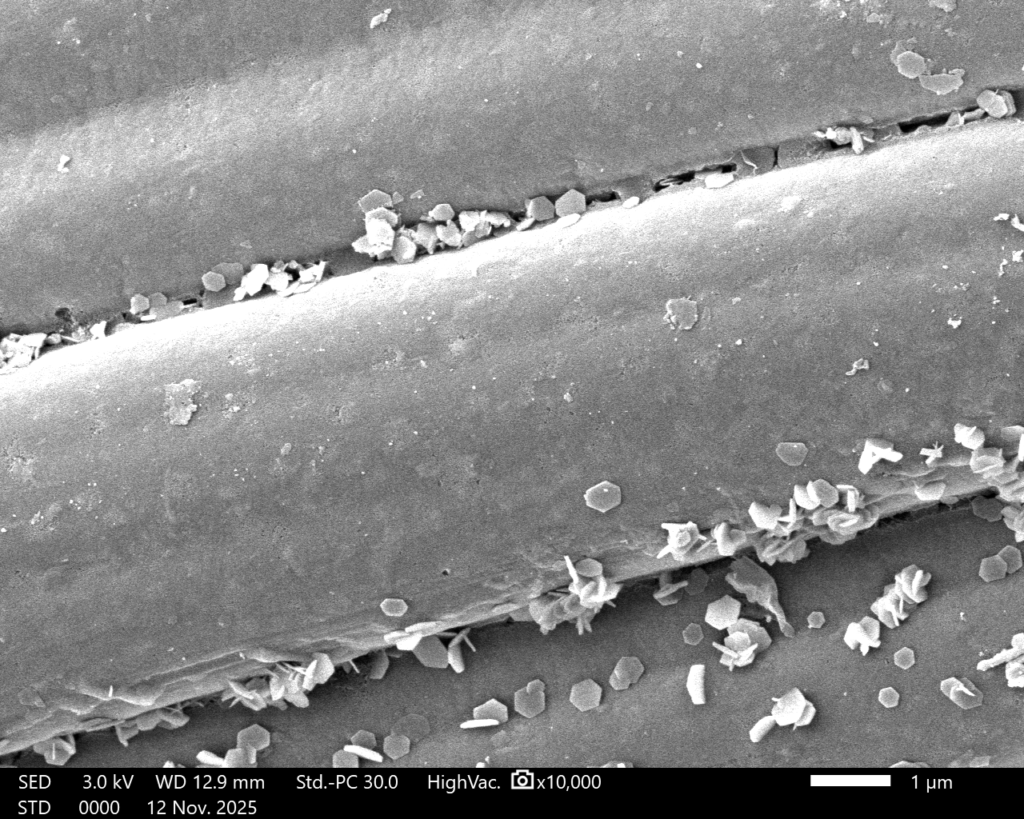
“After backwashing, the community on the granules stays the same composition every time,” says Larasati. That resilience is also what makes the granules so dependable over the 12-year timeframe studied: the biology is not fragile, and – importantly – does not drift unpredictably.

Understanding the biology is one thing; the second element of the study concerns the engineering around it. Downstream of BODAC® in Nieuw-Amsterdam, water passes through reverse osmosis membranes. Upstream, ultrafiltration has been used as a pre-treatment step. But Larasati et al. found this is by no means a requirement for the bacteria to do their work. “A much simpler drum sieve does well,” she says. “The BODAC® still removes more than 80% of the organic micropollutants of interest.” For water reuse applications where ultra-pure output is not the goal, this significantly simplifies  the treatment and lowers its cost.

The third and final element of the study was predicting the BODAC® workings for designing new reactors. Larasati: “The long-term data from the Nieuwater has provided a rare, empirically grounded foundation for what the technology is capable of. We used that data from the pilot to estimate the required size of future reactors, as well as the conditions needed for the process, given the pollutants and their concentrations at the inlet.”

Serious candidate for broader deployment
Taken together, the work reframes BODAC® from the remarkable curiosity of a single industrial plant into a serious candidate for broader deployment in water reuse – biologically robust, surprisingly versatile, and well-suited as a quaternary treatment step or in applications well beyond its original industrial context.

Read more:
Larasati, Amanda, Daniela De Cata, Leone Mazzeo, et al. 2026. “Modelling and Pilot-Scale Testing of Aged Biological Activated Carbon Filters Predict the Optimal Contact Time for Micropollutant Removal from WWTP Effluents.” Chemical Engineering Journal 529 (February): 172663. https://doi.org/10.1016/j.cej.2026.172663.

Towards an economy of value preservation | By Niels Faber

Abstract

The realisation of a circular economy has thus far unfolded under the assumption that it would fit within existing economic arrangements. In practice, we witness many circular initiatives struggling to give shape to their ambitions, let alone develop to maturity. These past months, various material recycling organisations terminated their activities, seeing virgin alternatives from other parts of the world flooding the market at prices against they cannot compete. If the transition towards a circular economy (i.e. an economy of value preservation) is to be taken seriously, a new perspective on value in our economic system seems unavoidable, as the rewriting of the rules of the economic game. At this moment, current perceptions of value stand in the way of this transition both at micro as well as macro levels. Several contours for a collective exploration of new directions of value and economic configuration that foster circular transition will be addressed.

Searching Innovation for the Common Good | By Cees Buisman

Abstract

In his key note he will conclude after a life of innovations that it is impossible that humanity will stay within the save planetary boundaries with innovation only. We should be more critical about the behaviour of the rich population in the world and more critical about new innovations that prove to be dangerous, like the PFAS crisis shows at this moment. In his keynote he will investigate how to look at the world that can stay within the save planetary boundaries, how should we change ourselves? It is clear if we only talk about the words of science and systems we miss the essential words of how we should cooperate and change ourselves. And his search for coherent save innovations. Which innovations will be save and will lead to a fair and sustainable world? And will lead to a world we want to live in.

Future-fit economic models: What do they have in common – how can they join forces? | By Christian Felber

Abstract

There is a growing number of new sustainable, inclusive, cohesive, participatory, just and humane economic models. A possible next step in the discourse about them is the comparative analysis in order to find out key commonalities, potential synergies, and “requirements” for a future-fit economic model. The author and initiator of the Economy for the Common Good provides an overview of these „new sustainable economic models“ and compares them according to underlying values, principles, and practical ways of implementation. The keynote addresses the cooperative spirit of the conference and prepares the ground for its public highlight on the eve of June 3rd, the round table with representatives of diverse future-fit economic models.

The era of postgrowth economics | By Matthias Olthaar

Abstract

The scientific debate on whether economies should always continue to grow increasingly becomes a political and societal debate. On the one hand further growth for the most affluent countries seems neither possible nor valuable, but on the other hand there is still lack of understanding and knowledge what a non-growing economy should look like and could best be governed. In this lecture we discuss various policy measures that can be realistically implemented, take into account government finances and aim at a higher quality of life despite a non-growing economy.

Democratic principles for a sustainable economy | By Lisa Herzog

Abstract

Democracy is under pressure, and less and less able to stir the economy into a sustainable direction. Therefore, to stabilize democracy and to make possible the socio-ecological transformation of the economy, democratic principles need to be implemented directly in the economy. This is not only a matter of morality, but also has practical advantages. Democratizing the economy can increase legitimacy and take advantage of the “knowledge of the many” to accelerate the transformation. Democratic practices, especially deliberation, allow bringing together different forms of knowledge, which is crucial for the local implementation of principles of social and ecological sustainability. This talk explores what this idea means in more concrete terms, from democratic participation in the workplace to the democratization of time.

Market, state, association, and well-being. An historical approach | By Bas van Bavel

Abstract

Over the past decades, markets have conventionally been seen as the best instrument to stimulate economic growth and enhance prosperity and well-being. The automatic link between markets and economic growth is increasingly questioned, however, as well as the automatic link between economic growth and enhancement of well-being. This has led to attempts to capture well-being development more directly than through GDP per capita figures and has produced a more variegated picture of well-being growth. Also, this has led to a shift of focus to other coordination systems than the market, as primarily the state but increasingly also the association. Analyses of the historical record suggest that especially the latter could be a vital component in future well-being.