
Search
Log in

Type of project: BSc/MSc thesis/internshipTopic: Electrospun polymer nanofibers for durable bipolar membranes in high-current electrochemical applications
Duration: 4-6 months
Start date: May/June 2026 (can be negotiated)
Location: Wetsus, European centre of excellence for sustainable water technology, Leeuwarden, NL.
Allowance: The maximum Wetsus allowance for this internship is 425 € per month. Grant holding students (i.e. Erasmus or other) receiving financial support of less than 425 € per month can apply for a top-up supplement to the maximum allowance.
Background:
Electrochemical technologies are playing an important role in the transition to a more sustainable energy system. For example, renewable electricity can be used to split water and produce hydrogen, a clean energy carrier. Similar electrochemical processes are also used for CO₂ capture, resource recovery, and the production of sustainable chemicals.
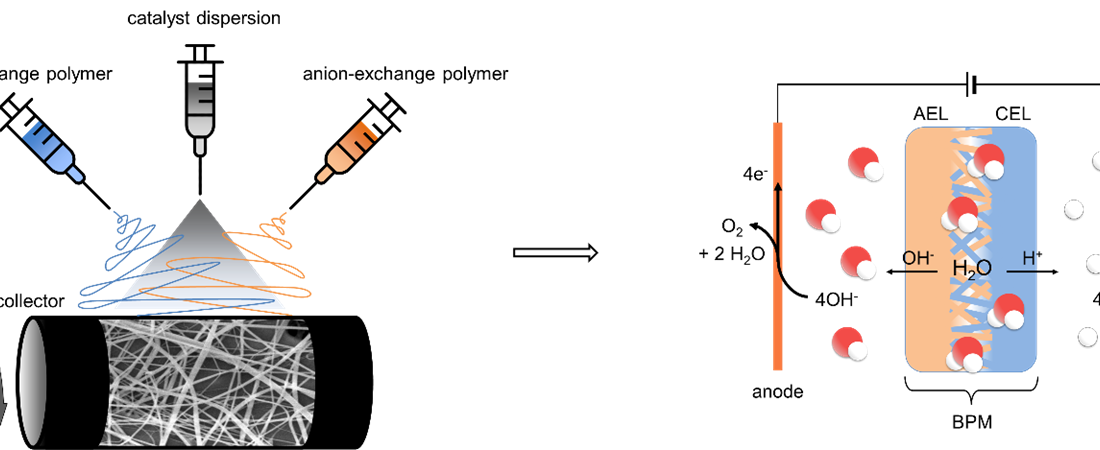
Bipolar membranes (BPMs) are key components in these systems. A BPM consists of two different ion-exchange layers joined together. When an electric field is applied, water molecules at the interface split into protons (H⁺) and hydroxide (OH⁻) ions, as illustrated in the figure below (right). This property enables their use in electrochemical devices, such as electrolyzers.
Recently, electrospinning has emerged as a promising method to fabricate BPMs. In this technique, polymers are spun into extremely thin nanofibers that form an interconnected membrane structure. As illustrated in the figure below, the nanofibers of the two ion-exchange polymers are allowed to entangle, forming a strong interface. Compared with conventional membrane fabrication methods, this nanofiber structure can provide a larger interfacial area and improved mechanical durability. However, because this approach is relatively new, the fabrication process still requires further optimisation and understanding.
Project Description:
In this project, you will contribute to the development of a next-generation bipolar membrane designed to operate at high current densities for extended periods of time.
Your work will focus on understanding how the electrospinning process influences the structure and performance of the membrane. You will investigate how different polymers and spinning parameters affect the formation of nanofibers and the properties of the resulting membrane.
During the project you will:
Your profile:
Education:
Skills:
Eligibility:
How to apply:
Please upload your CV (max. 2 A4 pages), a short motivation letter (max. 1 A4 page), and a list of the attended courses and the equivalent ECTS via the application form provided (in English). In the Message, please indicate your expected starting and end date. Feel free to contact Tomas Cervenka (tomas.cervenka@wetsus.nl) if you have further questions or need more information.