Search
Log in


The people behind the science, and the science behind the people.
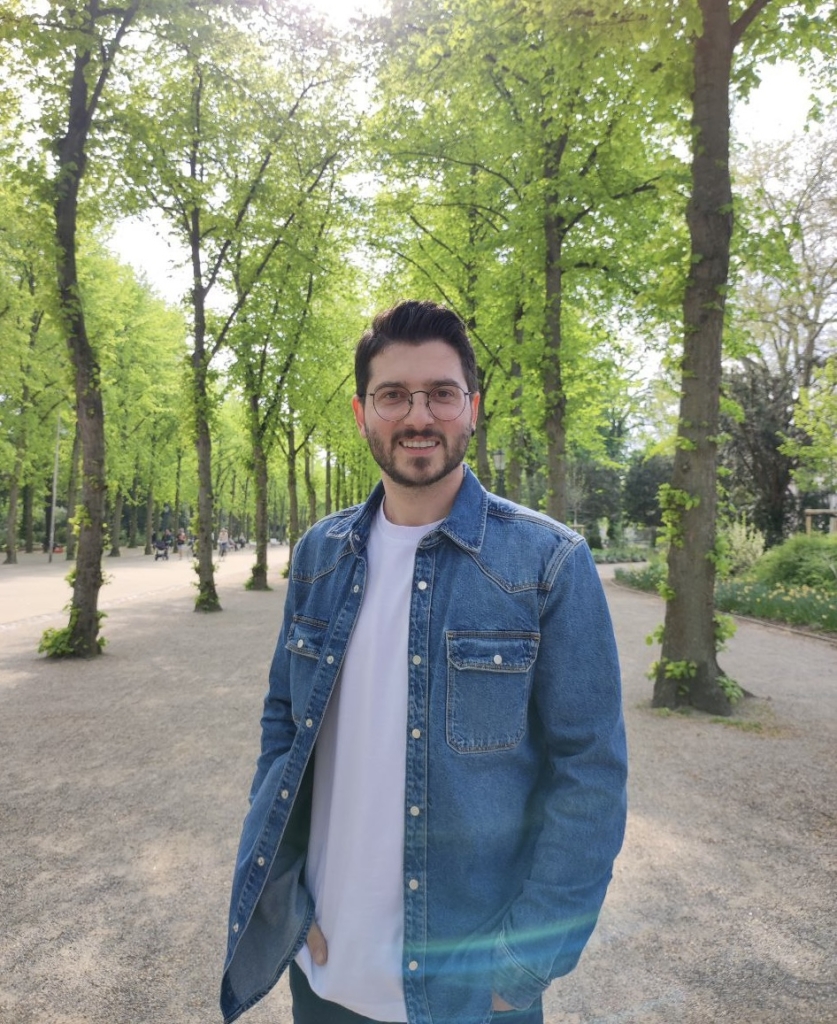
It takes a certain kind of courage to dedicate a career to the exact problems everyone else avoids. Mirvahid Mohammadpour Chehrghani is one of those people who simply doesn’t give up – a trait he credits to his ever-encouraging father. With Mirvahid’s PhD, he challenged the world to reconsider the immense length of drinking water pipes buried beneath our feet, by giving them a shark-skin-inspired lining: an innovation for a system that has remained largely unchanged for millennia.
Growing up, Mirvahid was always drawn toward an academic path, in part because of his father as his teacher and on top of that, a fantastical storyteller who could bring the most mundane experiences to life with warmth and real emotion. It mesmerized the young Mirvahid every evening, and as soon as he had the chance to tag along to his father’s classes, at the age of four, he made sure to be there.
Yet Mirvahid’s own school years told a different story. Much of that time was spent instead at his family’s dairy farm, and with school never posing much of a challenge, his motivation slipped. It wasn’t until after his military service, when he left for university in Turkey, that the real test began. And it hit him hard. He nearly failed his first semester, and when push came to shove, he gave himself one more chance. After all, “no half-finished jobs” was something his father always said, so giving up was not an option.
That became the quiet motto that carried him through long days spent studying in the library, the rest of his time at home only reserved for sleep. Starting almost from scratch in subjects like physics and math, Mirvahid worked relentlessly just to keep pace with his classmates.
When he found himself near the top of his year not long after, he barely trusted it. Is this really working out, or am I just lucky? It took time to realize it wasn’t luck at all – it was the direct result of choosing, again and again, not to back down from a hard thing.
That instinct eventually pointed him toward heat transfer and fluid dynamics: the two subjects notorious for scaring off much of a mechanical engineering cohort. While others dreaded the unintuitive, abstract nature of the material, not to mention the early morning classes, Mirvahid thrived in it. It became his niche, earning him a scholarship at another Turkish university and, eventually, a PhD at Wetsus.
Picking the Netherlands wasn’t purely a scientific decision. Somewhere between hunting for PhD positions across the globe, priorities like “reasonably close to home,” “surprisingly tolerable weather,” and “a culture that doesn’t confuse long hours with good work” started to matter just as much as the research itself. The final choice came down to Eindhoven, researching hydrogen storage, or Leeuwarden, to build superfluent flow in pipes. The latter topic won him over with its purely fluid dynamic views – and with it came a new home in a country of smiling strangers, ever-present bicycles, and an impressive volume of official letters from the municipality he had never seen before.
At its core, Mirvahid’s research chased a simple but stubborn question: how do you move water through a pipe more efficiently? He worked through a string of ideas – smooth coatings, injected bubbles, and many more – before landing on something borrowed straight from nature: the microscopic texture of shark skin. It had been used before, in aircraft design, swimsuits, and elsewhere, but never in the very different context of drinking water pipes. He knew immediately this was the challenge he wanted to take on.
For a moment, it felt like the breakthrough he’d been chasing. That moment was shadowed almost immediately by loss, as his father passed away around the same time. It’s a loss Mirvahid still carries with him, alongside the quiet certainty that his father would have wanted nothing more than for him to keep going.
So he did. A test rig was built and calibrated against known benchmarks, and new pipes were 3D printed – on specially acquired printers capable of a 0.05 mm resolution – with the shark-skin-inspired texture bolted on. The little ridges and riblets resulted showed a six percent efficiency gain. Encouraging, but real drinking water networks don’t run at one constant speed; demand rises and falls throughout the day, and the early design couldn’t hold its advantage across that range – a problem no one had chased quite this way before.
It sent Mirvahid back to the drawing board, this time toward a staggered design of riblets in varying sizes, tuned to the different vortices that otherwise drag along the pipe wall. The refined design held up: the surface alterations managed to reduce the water’s resistance to the pipe. and the result became both a patent and a spot in the national news.
The final test came outside the lab entirely – sitting down with technicians at a production facility, working within the realities of full industrial scale. The results didn’t just confirm the lab findings, they exceeded them: the efficiency gain was even larger than predicted. Exactly why remains, for now, an open question. Even Mirvahid admits it’s a bit of a mystery still.
Mirvahid had long assumed his future was in academia, ever since he first realized how much he could thrive in it. But these past years have given him a genuine taste for industry too – the hands-on problem-solving, the direct line from idea to factory floor. It left him wondering whether the next step might be building something of his own.
Looking back, he’s grateful to the people who shaped the journey, for the opportunities that came his way, and for meeting his wife along the way. And finally, he knows he can be proud – as his dad would be.